Throwing sticks : a Prehistoric weapon that evolved since the origin of the wooden tools
It
seems evident that the first objects man threw to survive be a stone or
a branch. In the same manner than man improved his tools made of stone,
the wooden tools evolved as well. The main difference is that we now
know well the former while we know little about the latter since wooden
tools tended to disappear after a few millenniums of decay, unless they
were preserved in particular and rare circumstances. The throwing
stick, as a hunting weapon, probably preceded the assegai (or spear)
and certainly the bow. As a survival tool during the Paleolithic
period, it probably was used in many ways that can be observed with the
Australian Aborigines. Throwing sticks were certainly rugged
originally, close to a simple polished and straight stick that didn't
come back. This type of archaic throwing stick most likely existed
several hundreds of thousands of years ago. Then, in order to improve
the performance and range of his weapon, man cut that stick down
further and further, sharpening it and making it lighter. These
improvements make it necessary for man to choose bent branches that
stabilize the flight of these throwing sticks, probably invented in the
early Upper Paleolithic Period that the Oblazowa discoveries suggest.
This generation of lighter throwing sticks increased the flight height,
allowing birds hunting with sticks that could go higher and farther
than ever, requiring even less force to throw by the end of the Upper
Paleolithic Period (around 20,000 years ago).
Man must have sometimes observed curved flights when throwing these
sticks due to natural torsion or induced during the manufacture process
of these lighter sticks, creating the first returning throwing stick
similar to the Australian Aborigines boomerangs. The invention of the
boomerang didn't happen in one day and is not due to chance. Imagine
the fascination of the first men who saw a throwing stick perform a
curved flight and coming back to its launching position!
The earliest object looking like a throwing stick and identified as
such was discovered in Oblazowa in Poland. It is dated around 23,000
BC, features a light curved shape, of 71 cm (27.95 inches), carved out
a mammoth tusk, plano-convex (already!) and quite heavy with 800 grams
(28.2 ounces). Tests performed with a copy of this hunting stick showed
that is worked perfectly and had a range of 60 meters (almost 200
feet).
Here is a chronology of archaeological discoveries of the throwing stick, the boomerang or any of their representations:

" Maybe because man started throwing sticks since the beginning, we feel a strange familiarity while holding a throwing stick."
From the third millennium BC in
Mesopotamia, we can find evidence of the use of throwing sticks in the iconography and texts of the era
The throwing stick, first a hunting stick that evolved into a
returning stick of a boomerang type, has its root during the Upper
Paleolithic Period in the same way that the propellant prehistoric
spear and other wooden tools that appeared as soon as stone tools where
advanced enough to allow precise work on wood materials.
In fact, paintings in Kimberley, Australia dating back 17,000 years
link human figures and boomerangs. They're called "Bradshaw figures" or
"Guyon Guyon".
The throwing stick as a prehistoric tool existed on all 5
continents, even if it was in Australia that the Aborigines used it the
most. This allowed them to pass the knowledge of its use and
manufacture through generations until today.

In Australia, the oldest wooden boomerang,
discovered at Wyrie Swamp in 1973
dating back 10,000 years!
In
Europe, particularly in the north, a throwing stick made of maple wood is 6,000 years old and was found in Braband, Denmark.
In Holland, an oak-made returning boomerang that is 2,300 years old was found in a bog around Velsen.
In
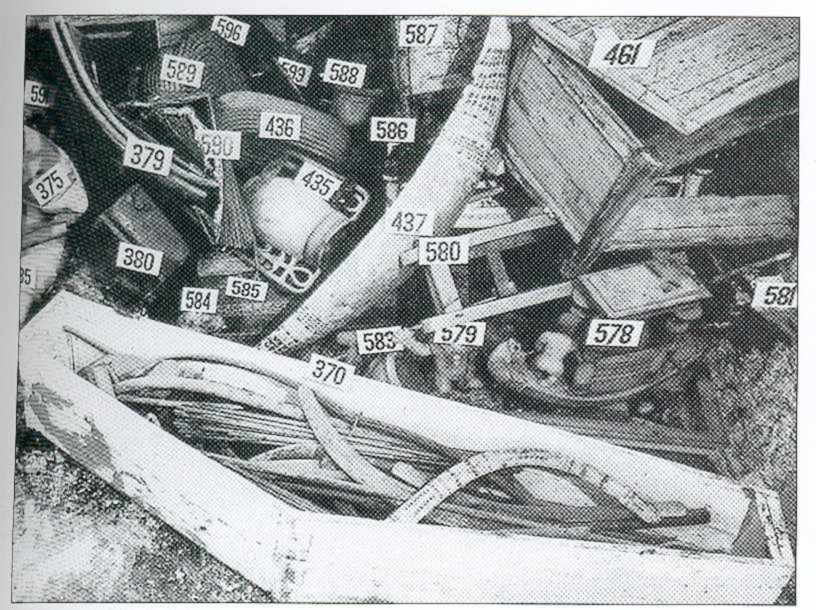
Egypt, a set of funeral throwing
sticks comprised of symbolic throwing sticks, hunting sticks and
boomerangs, was found in the tomb of Tutankhamun in the Valley of the
Kings by Howard Carter and Lord Carnavon in 1922.
Box containing the young
king collection
We can find evidence of the use of throwing sticks since the Neolithic Period in other regions of
Africa, especially in the northern part of Sahara where is it represented in engravings and paintings on rocks.
On the North
American continent
in Arizona, the Hopi tribe used rabbit sticks for rabbits hunting. Some
date back 1,300 years ago. But the oldest discovery in the new world is
without a doubt the one in Little Salt Lake, Florida dating back 9,000
years ago, the earliest on this continent.